How to Transition to Clean Beauty: A 2026 Guide

Table of Contents
- Start Your Clean Beauty Routine for Beginners
- What to Replace First When Transitioning to Clean Beauty
- How to Read Skincare Ingredient Labels Without Getting Overwhelmed
- Your Clean Beauty Ingredient Checklist
- Finding Clean Beauty Products on a Budget
- How Long Does the Transition Take?
- Conclusion
- Frequently Asked Questions
Last Updated: October 16, 2026
Start Your Clean Beauty Routine for Beginners
Learning how to transition to clean beauty starts with one honest question: what is actually in the bottle you use every wash day? Clean beauty is the practice of choosing hair and skin products formulated without ingredients linked to irritation, hormone disruption, or long-term health concerns, while prioritizing transparency about what goes into each formula. This guide from Naturally Love Hue walks you through the switch in a manageable order, so you are not throwing out your entire shelf at once. The good news: you do not need a full cabinet overhaul to see a difference.
What Clean Beauty Actually Means
Clean beauty is a term for personal care products made without a defined list of questionable ingredients, such as parabens, phthalates, sulfates, and synthetic fragrances. There is no single legal definition, so brands set their own standards, which is exactly why label reading matters. The U.S. Food and Drug Administration's cosmetics guidance notes that cosmetic ingredients and labeling are largely self-regulated, meaning the burden falls on you to check what a product contains.
The Three-Product Starter Approach
A clean beauty routine for beginners works best when you start small. Pick three products you use most often, typically your shampoo, conditioner, and leave-in or moisturizer, and replace only those first. This keeps costs down and lets you judge results without confusion. If your scalp reacts badly to a new formula, you will know which product caused it.
What to Replace First When Transitioning to Clean Beauty
The order you replace products matters more than most guides admit. Prioritize anything that stays on your skin or scalp for hours, since longer contact means more absorption. Leave-in conditioners, oils, and body lotions sit on your skin all day; shampoo rinses away in under a minute. If you can only afford one swap this month, make it a leave-in or a scalp oil.
Priority Order for Hair and Skin Products
- Leave-in conditioners and curl creams
- Scalp and hair oils
- Body lotion and body oil
- Conditioners
- Shampoos and body wash
- Styling products like mousse and gels
When to Keep What You Already Own
Do not toss a product just because it is not "clean." If it works for your hair and you have not had a reaction, finish it. Throwing away half-used bottles wastes money and creates unnecessary waste. Replace items as they run out, one at a time, and you will build a cleaner routine without the financial sting.
| Product Type | Replace First? | Why |
|---|---|---|
| Leave-in conditioner | Yes | Long contact with scalp and hair |
| Scalp oil | Yes | Absorbs directly into skin |
| Body lotion | Yes | Sits on skin all day |
| Shampoo | Later | Rinses off quickly |
| Styling gel | Later | Lower priority, less contact |
How to Read Skincare Ingredient Labels Without Getting Overwhelmed
Reading a skincare label is simpler than it looks once you know the pattern. Ingredients are listed in order of concentration, from highest to lowest, so the first five names tell you most of what you need. If a questionable ingredient appears near the top, the product contains a meaningful amount of it. If it is near the bottom, the quantity is likely small.
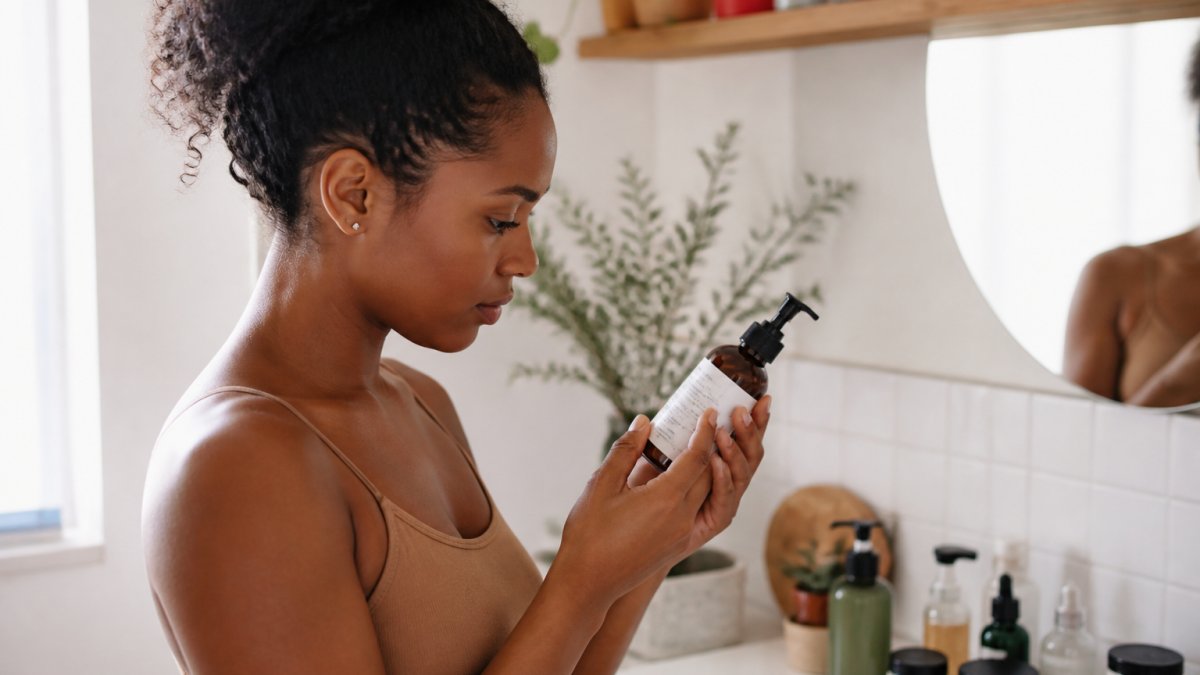
Focus on these positions rather than memorizing hundreds of chemical names. Scan the first five ingredients, check for fragrance near the top, and look for recognizable plant oils, butters, and vitamins. The Environmental Working Group's Skin Deep database lets you look up individual ingredients and see how they are rated for safety concerns, which helps when a name is unfamiliar.
Your Clean Beauty Ingredient Checklist
Use this clean beauty ingredient checklist when you shop. It covers the most common ingredients people choose to avoid and the ones worth seeking out. Print it or save it to your phone so you can check labels in the aisle.
Ingredients to avoid or limit:
- Parabens (methylparaben, propylparaben, butylparaben)
- Phthalates (often hidden under "fragrance")
- Sulfates (sodium lauryl sulfate, sodium laureth sulfate)
- Synthetic fragrance and "parfum"
- Formaldehyde releasers (DMDM hydantoin, diazolidinyl urea)
- Mineral oil and petrolatum in leave-on products
Ingredients to look for:
- Plant oils (jojoba, argan, castor, coconut)
- Shea, cocoa, or mango butter
- Vitamins like E and B5
- Herbal extracts (rosemary, nettle, horsetail)
- Full, transparent ingredient disclosure on the label
A short, readable ingredient list is usually a better sign than a long one padded with unpronounceable fillers. At Naturally Love Hue, our formulations blend herbs, vitamins, and minerals, and we list every ingredient so you can check it against your own priorities.
Finding Clean Beauty Products on a Budget
Clean beauty products on a budget are entirely possible if you shop strategically. The biggest mistake is buying an entire routine at once. Buy one replacement at a time, use it fully, then move to the next. This spreads the cost across months and prevents you from wasting money on products that do not suit your hair.
Three habits keep costs down without cutting corners:
- Buy multi-use products, such as a conditioner that doubles as a leave-in
- Choose larger sizes of items you use daily, since the cost per use drops
- Watch for starter kits that bundle a few essentials at a lower combined price
How Long Does the Transition Take?
Most people see the full benefit of a clean beauty switch within four to eight weeks. Your scalp and skin need time to adjust, especially if you are removing silicones that coat the hair and create temporary smoothness.
The timeline depends on how many products you swap and how often you wash. Someone who replaces three products at once may notice changes faster than someone replacing one every few months. Consistency matters more than speed. A customer who has used our hair growth oil for a little over five weeks reported visible growth during menopause-related thinning, which reflects the realistic pace of change rather than an overnight fix.
Conclusion
The hardest part of going clean is not finding products; it is resisting the urge to replace everything at once and then feeling overwhelmed when results are not instant. Start with three products, read the first five ingredients on every label, and give your scalp a full month to adjust. Naturally Love Hue was founded by a mother-daughter team to serve melanated hair and skin with naturally-derived, non-toxic, and vegan formulations that restore moisture and shine while addressing breakage and thinning. Our herb, vitamin, and mineral blends support healthy hair, skin, and nails without the ingredients you are trying to avoid. Get started with Naturally Love Hue and build a clean routine that fits your hair, your budget, and your pace.
Frequently Asked Questions
How do I start transitioning to clean beauty?
Start with the products that stay on your skin the longest, like leave-in conditioners, moisturizers, and body oils. Swap one product at a time so you can track how your skin and hair respond. Many people begin with hair care because it absorbs into the scalp, then move to facial skincare and makeup. A gradual approach lets you research ingredients properly and avoids wasting money on products that do not suit your texture or sensitivity.
What should I replace first when switching to clean beauty?
Prioritize products with the longest contact time and largest surface area: leave-in hair products, body lotions, facial serums, and moisturizers. Rinse-off items like cleansers and shampoos matter less because they spend only seconds on your skin. If you have a sensitive scalp or 4c hair prone to dryness, start with your leave-in conditioner and sealing oil, since those stay on your scalp and strands all day.
Do I need to throw away all my current beauty products?
No. Use up what you already own unless a product causes irritation, then replace it with a cleaner option when it runs out. This saves money and reduces waste. The exception is expired products or anything that triggers redness, itching, or breakage. For those, stop use immediately. A clean beauty ingredient checklist helps you decide which items to replace first and which can wait until they are finished.
How can I transition to clean beauty on a budget?
Focus on multi-use products that replace two or three items in your routine, like a hair oil that works as a scalp treatment and a sealant. Buy travel sizes or starter kits before committing to full sizes, and prioritize products with short ingredient lists since they often cost less. Sales, refill programs, and subscription discounts also lower the cost. You do not need a full 10-step routine to see results.
How do I read ingredient labels on beauty products?
Look for the INCI name list on the back or bottom of the packaging. Ingredients are listed by concentration, highest first. Scan the first five ingredients to see what makes up most of the formula. Check for fragrance, parabens, phthalates, and sulfates if those irritate your skin or scalp. Brands that publish full ingredient lists online make this easier. If a label only says 'natural' or 'botanical' without specifics, treat that as a marketing claim rather than proof.
What does 'clean beauty' mean, and is there a standard definition?
There is no single legal definition of clean beauty. Most brands and retailers use it to mean products made without a list of ingredients they consider potentially harmful, such as parabens, phthalates, sulfates, and synthetic fragrances. Because the term is not regulated, the exact banned list varies by brand. Read the full ingredient list rather than trusting the front label, and look for brands that publish what is not in their formulas.
How long does it take to transition to a clean beauty routine?
Most people take three to six months to replace their full routine if they swap products as they run out. If you replace everything at once, you can finish in a few weeks, but that costs more and makes it harder to identify which product causes a reaction. A slower pace also gives your scalp and skin time to adjust to new formulas, especially if you are moving away from sulfates or silicones.
How can I choose clean beauty products for my hair and skin type?
Match the product weight to your texture. Fine 4c hair that gets weighed down needs lightweight oils like grapeseed or jojoba, while thick, dry 4c hair benefits from heavier sealants like castor or shea. For skin, oily types do better with gel or lotion textures, and dry types need cream or oil-based formulas. If you are in menopause and noticing thinning, look for scalp oils with rosemary or peppermint, which support circulation without clogging follicles.