How to Use Rosemary Oil on Textured Hair (and What to Mix It With)
You've seen the videos. Everyone seems to be adding rosemary oil to their routine, and you bought a little bottle too. Then you read the label — "dilute before use" — and you're not sure what to dilute it with, how much to use, or whether it belongs on your scalp, your ends, or both.
If you're wondering how to use rosemary oil on textured hair without irritating your scalp or weighing down your curls, this guide walks you through it: which carrier oil for rosemary oil suits your hair, how to mix it, and how to fit it into a routine you'll actually keep up with.
What Rosemary Oil Is (and Why It's Everywhere)
Most rosemary oil sold in small dropper bottles is an essential oil — a highly concentrated plant extract. It has a fresh, herbal scent and a cooling, tingly feel on the scalp, which is a big part of why people love it as a scalp massage oil.
Its popularity also comes from research. A small 2015 study compared rosemary oil to a common over-the-counter treatment for one type of hair thinning and found similar results after six months. It's an interesting finding, but it was one small study, and it's not a reason to treat rosemary oil as a fix for any hair or scalp condition. If you're dealing with noticeable thinning, shedding, or a scalp that itches or flakes persistently, a dermatologist is the right first stop.
For everyday care, think of rosemary oil as a way to make your scalp routine feel refreshing and consistent — and consistency is what keeps hair looking its healthiest.
Why You Should Never Use Rosemary Oil Straight
Essential oils are strong. Applied undiluted, rosemary oil can sting, cause redness, or leave your scalp feeling irritated — especially if you have sensitive skin or just took down a protective style. That's where a carrier oil comes in. A carrier oil "carries" the essential oil, spreading it out so it's gentle enough for your skin, and it adds slip and softness of its own.
One exception: if your rosemary product is already blended (a serum, balm, or "rosemary-infused" oil), it's already diluted. Use it as directed — don't add more.
How to Choose a Carrier Oil for Rosemary Oil
The best carrier oil for rosemary oil depends less on your curl pattern and more on how your hair handles oil. Here are the most common options, from lightest to richest:
- Jojoba oil — Very light and close to your scalp's natural oils. A great all-around pick, especially for fine strands or low porosity hair.
- Grapeseed oil — Thin and fast-absorbing, with almost no greasy feel. Good if oils usually sit on your hair.
- Sweet almond oil — Light to medium, softening, and easy to find. Skip it if you have a nut allergy.
- Argan oil — Light and glossy; nice for both scalp and ends.
- Avocado oil — Medium-weight and nourishing; great for thicker, drier hair.
- Castor oil — Very thick and rich. Many people love it for edges, but it can be hard to spread on its own, so it's often mixed half-and-half with a lighter oil.
Quick rule: if heavy oils leave your hair greasy but still dry (a classic sign of low porosity), go with jojoba, grapeseed, or argan. If your hair drinks oil up and still feels thirsty, a richer blend with avocado or castor will feel better.
How to Mix Rosemary Oil: A Simple Recipe
- Start with your carrier. Add 1 tablespoon (about 15 ml) of carrier oil to a small, clean bottle — an applicator bottle with a nozzle makes it easy to reach your scalp between parts.
- Add rosemary oil. Use about 3–5 drops per tablespoon. Start at the low end if your skin is sensitive.
- Shake well before every use.
- Patch test first. Dab a little on the inside of your arm or behind your ear and wait 24 hours. Any redness or itching? Don't use it.
- Store it in a cool, dark place and make small batches so it stays fresh.
Want a little extra? Some people add a drop or two of peppermint oil for more of a cooling tingle. Keep the total essential oil count low — more drops don't mean better results.
How to Use Rosemary Oil on Textured Hair
1. Apply it to your scalp, not your whole head
Part your hair into sections and apply a few drops along each part. Your scalp is where rosemary oil is meant to go — there's no need to saturate your lengths.
2. Massage for a few minutes
Use the pads of your fingers (not your nails) and work in small circles for 3–5 minutes. A scalp massage feels great, helps spread the oil evenly, and turns this into a relaxing ritual you'll want to keep.
3. Decide: pre-poo or leave-in
As a pre-poo, apply it 30 minutes to a few hours before washing, then shampoo as usual. This is the best option if oils tend to build up on your hair. As a leave-in scalp treatment, use a very small amount on a clean, dry or damp scalp 2–3 times a week.
4. Be consistent
A scalp routine works best when it's steady. Pick days that fit your wash schedule — for example, a pre-poo on wash day plus one midweek massage — and stick with it.
5. Or skip the mixing
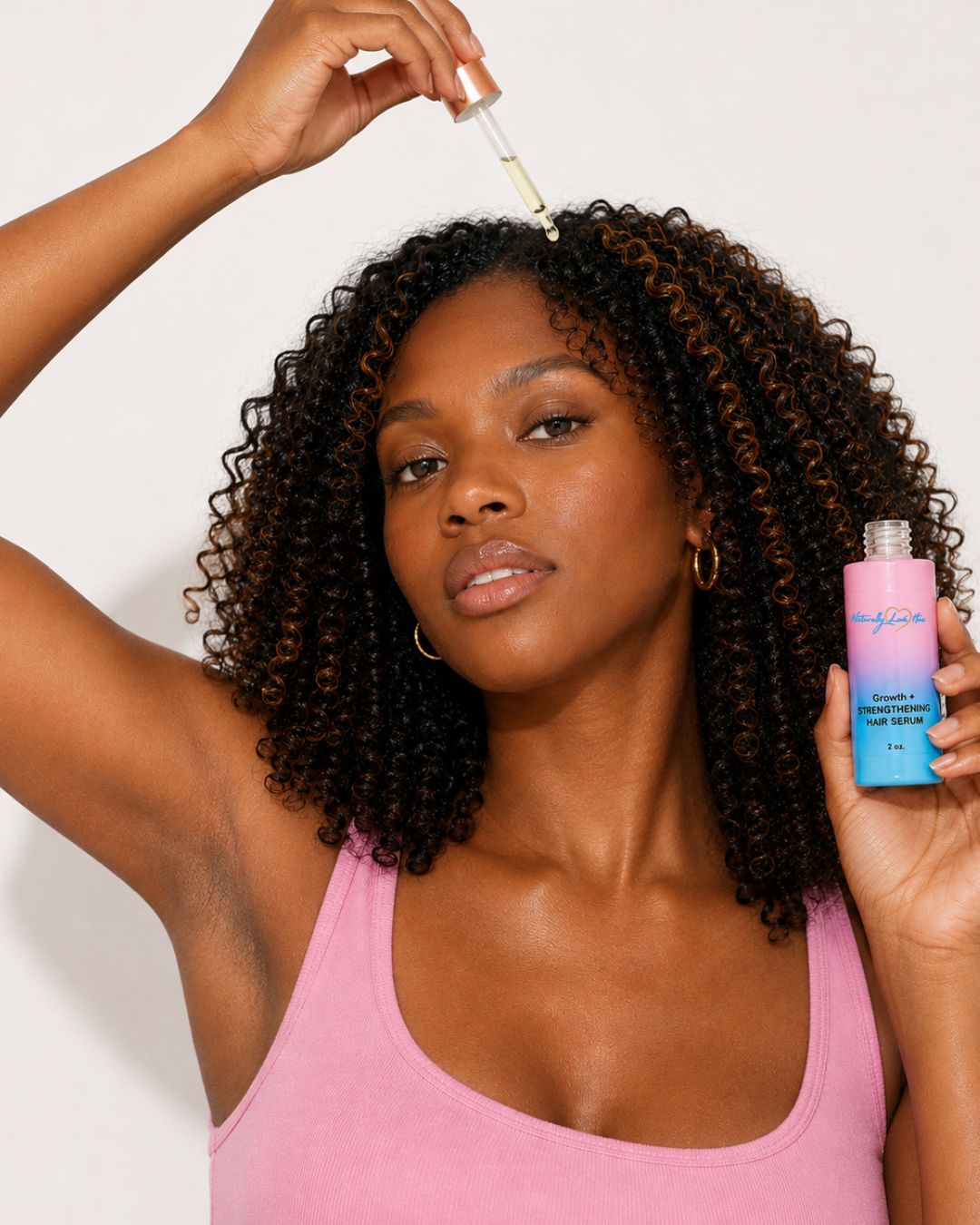
If measuring drops isn't your thing, a ready-made formula takes the guesswork out. Our Growth+ Strengthening Hair Serum pairs rosemary oil with caffeine extract, turmeric extract, avocado oil, and peppermint oil in a lightweight, non-greasy serum made for your scalp and edges — no dilution needed.
Common Mistakes to Avoid
- Using it undiluted — the fastest way to an irritated, tingling-the-wrong-way scalp
- Adding too many drops — stronger isn't better
- Pouring it over your lengths — focus on the scalp and keep your curls light
- Applying it over buildup — start with a clean scalp so the oil isn't sitting on old product
- Skipping the patch test, especially if you have sensitive skin
- Getting it near your eyes — keep it away from your face when you massage near the hairline
Rosemary Oil FAQ
What is the best carrier oil for rosemary oil?
Jojoba oil is the best all-around choice because it's light and similar to your scalp's natural oils. If your hair is thick or very dry, avocado oil or a castor-and-jojoba blend may feel more nourishing.
How often should I use rosemary oil on my hair?
Two to three times a week works well for most people. Watch how your scalp responds — if it feels irritated, cut back or stop.
Can I leave rosemary oil in my hair overnight?
Yes, a properly diluted blend can stay on overnight. Cover your hair with a satin bonnet or scarf, and wash it out on your next wash day if your scalp starts to feel coated.
Can I use rosemary oil on my edges?
Yes — just use a tiny amount of a diluted blend and massage gently. Your edges are delicate, so avoid tight styles and heavy tension in that area too.
The Bottom Line
Using rosemary oil on textured hair is simple once you have the right mix: always dilute it in a carrier oil that suits your hair, focus on your scalp, massage it in, and keep a steady routine. Patch test first, and check in with a dermatologist for anything that feels like more than everyday dryness.
Prefer something ready to go? Try our Growth+ Strengthening Hair Serum for lightweight scalp care, or the Scalp & Hair Balm — a rich blend of rosemary, castor oil, biotin, and vitamin E that soothes dryness and helps reduce breakage.